
Pyxa Early Access
A time-limited program for research labs to pioneer 3D spatial multi-omics in intact, thick tissue.
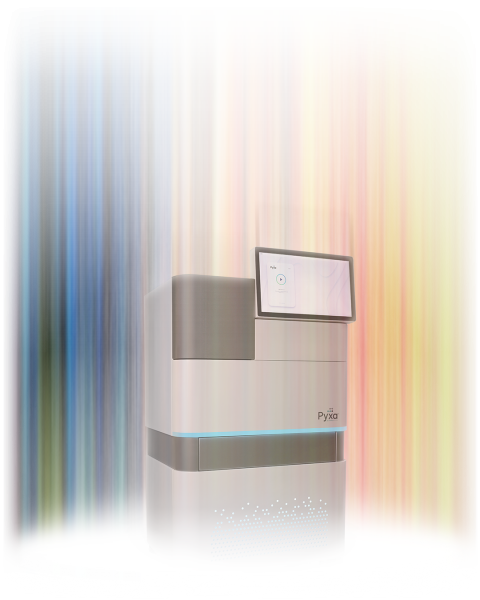
Welcome to a new frontier where biology is explored in its native 3D context.
Pyxa is engineered to carry researchers beyond the limits of 2D snapshots and into intact, volumetric biology. By enabling 3D spatial multi-omics in thick tissue, Pyxa reveals the cellular neighborhoods, gradients, and interactions that shape function and enable researchers to boldly explore the new depths of biology. Using Pyxa, you’ll find clearer insight into complex disease mechanisms and chart the paths to new therapies.
- See biology in 3D, intact tissue up to 100 µm thick
- Designed for multi-omic analyses using STARmap (transcripts), RIBOmap (active translation), and STARmap PLUS (protein)
- Identify rare cells, editing events, and complex structures that 2D methods miss
Be among the first to navigate new depths of spatial biology in 3D
Pyxa Early Access is your ticket to:
- A limited time program to join pioneers in spatial biology with introductory pricing
- Partner closely with Stellaromics as you push into new tissues, workflows, and 3D-first questions
- Explore volumetric data with tools built for 3D—visualize patterns across layers, not just on a slice
- Access to PyxaStudio, an analysis platform specifically designed for visualizing data in 3D
- Priority support from Stellaromics R&D team for application development
Pxya Early Access Program FAQs
What is Pyxa Early Access?
Pyxa Early Access is a time-limited program for select labs to adopt Pyxa and collaborate closely with Stellaromics on workflows, tissue expansion, and new applications.
What tissue thickness is supported?
Pyxa is designed for intact tissue sections up to 100 µm, preserving native architecture and spatial context.
What analysis tools are included?
PyxaStudio™ enables volumetric visualization and analysis designed for 3D spatial datasets.
How limited is the program?
Availability is limited to customers who place an order before the end of June 2026.
What’s expected of Early Access participants?
A collaborative partnership—share feedback, explore new tissues or workflows, and help shape what comes next.
Ready to explore biology in true 3D?
Tell us your tissue type and research goals. We’ll follow up with next steps for Early Access.